

Rev 2 hardware is in fabrication. Here’s where things stand. Background The Rejuv is a handheld red and near-infrared light therapy device designed around a specific principle: that delivered dose — measured in J/cm² at the treatment surface — should be known, not estimated. Every unit is individually calibrated using a NIST-traceable optical power meter […]
Category Archives: Uncategorized
04
Feb
Feb
1. Why measurement matters When evaluating a photonic device, the quantity of interest is the optical power delivered per unit area. As the LEDs are spread out, so too is the energy. Because the LEDs are distributed across a surface, the emitted energy is similarly distributed, making irradiance—not total electrical input power—the relevant metric. In […]
A common criticism of compact, battery-powered devices is that they do not deliver sufficient total optical power (“watt”), particularly when compared to large, AC-powered panels. What determines local irradiance, however, is power density (mW/cm²) rather than total emitted power. For a given power density, total required power scales directly with emitting area: larger panels necessarily […]
24
Jan
Jan
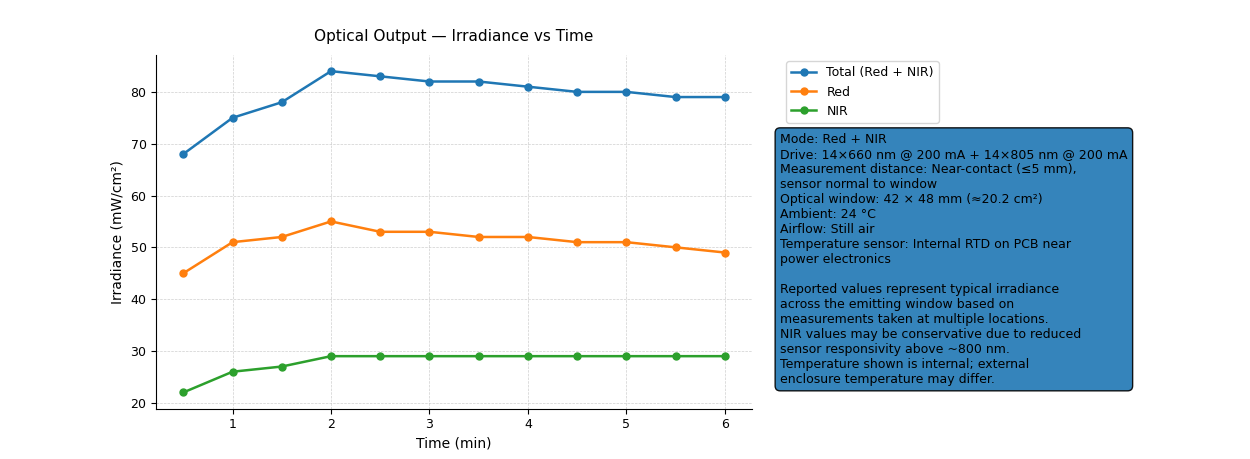
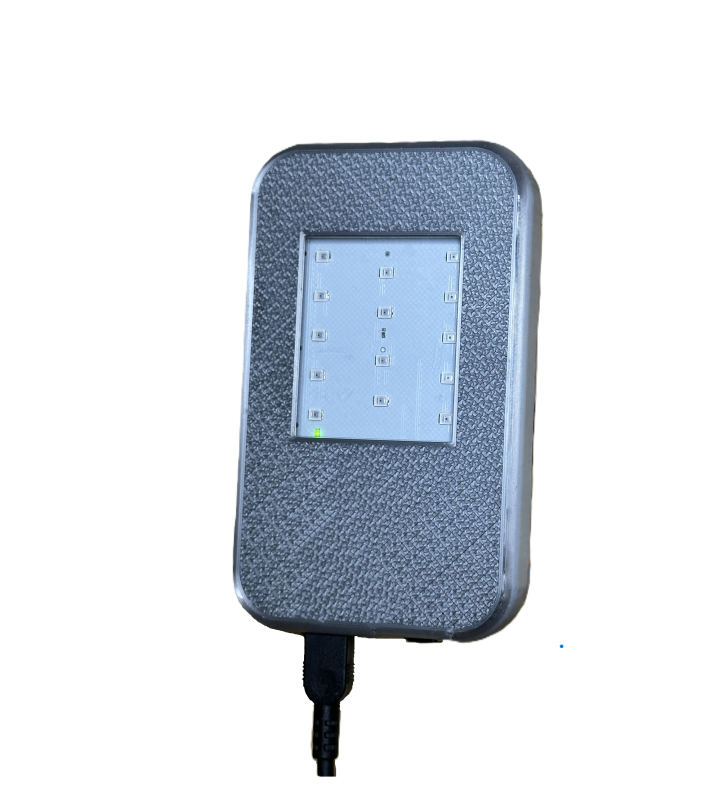
This post documents the optical and thermal behavior of the current generation device. Older blog posts document earlier design iterations and are retained for historical context. Purpose This post summarizes optical output and thermal behavior measurements for the current generation of the Rejuvulite handheld red / near-infrared device. It is intended to provide transparency into […]
Simple Devices aren’t Simple At first glance, a handheld light-emitting device appears straightforward: an array of LEDs, a battery, and a housing. In practice, aligning such a device with the optical power densities commonly referenced in published light therapy research presents a set of nontrivial engineering constraints. To illustrate why, consider irradiance on the order […]