
1. Why measurement matters
When evaluating a photonic device, the quantity of interest is the optical power delivered per unit area. As the LEDs are spread out, so too is the energy. Because the LEDs are distributed across a surface, the emitted energy is similarly distributed, making irradiance—not total electrical input power—the relevant metric.
In battery-powered devices, the electrical energy available is limited, and a significant fraction of the input power is inevitably lost as heat rather than converted into usable optical output. Any energy dissipated as heat is energy that is not delivered to the target tissue. As efficiency decreases, heat generation increases, which in turn constrains how much optical power can be sustained without exceeding thermal limits.
For this reason, efficiency directly limits achievable irradiance, and measuring the actual optical output under operating conditions is essential. Electrical specifications alone are insufficient; what ultimately matters is what is delivered at the surface of use.
2. What was measured (and why)
As presented in the measured performance section, the primary metrics measured were:
- Irradiance (mW/cm²)
- Temperature (°C)
- Battery voltage (V)
- Current delivered to the LEDs
- Time dependence of all of the above
Temperature, battery voltage, and LED current are measured internally by the device and monitored continuously during operation. Irradiance is measured using a separate external optical power meter.
These measurements were chosen to capture the full operating state of the device. For example, a decrease in battery voltage could potentially affect LED current and, in turn, the delivered irradiance. Identifying whether such correlations exist is critical, as the design objective is to maintain a consistent irradiance independent of battery state. Measuring all parameters simultaneously allows these interactions to be identified and quantified.
3. Test setup (high value section)
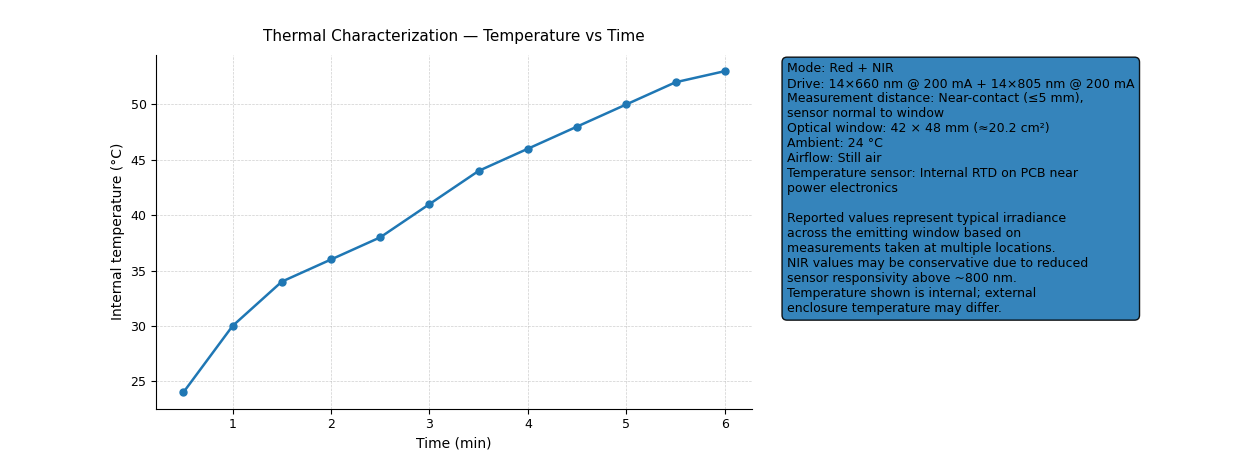
During testing, temperature of the printed circuit board, battery voltage, and LED current were monitored and logged via USB using a companion application connected to the device. The printed circuit board was fully assembled into the RejuvULite enclosure, ensuring that thermal conditions reflected normal use.
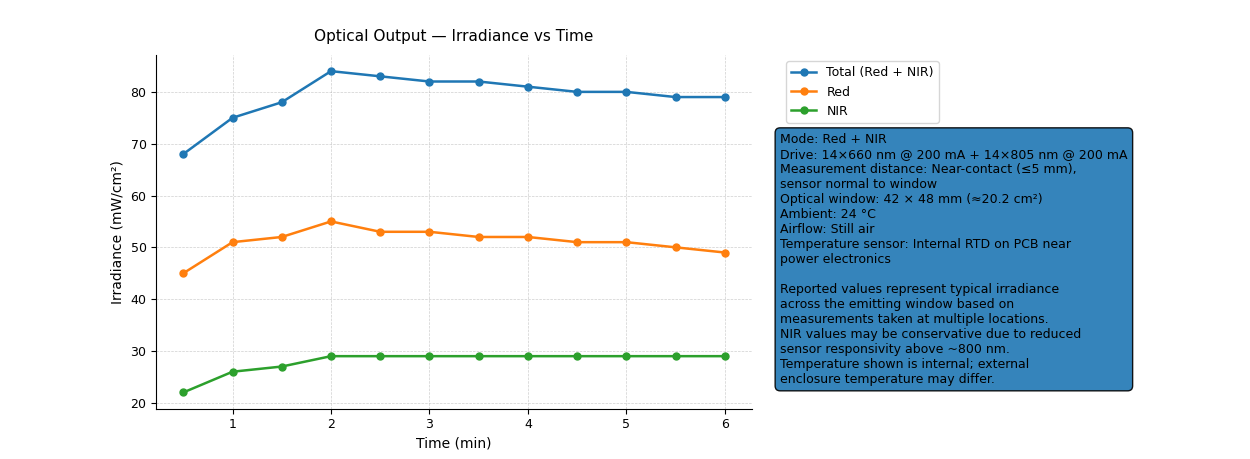
Irradiance was measured with the optical meter placed directly against the lens, corresponding to the intended treatment distance. Unlike large panel-style devices that are designed to operate at a distance, RejuvULite is intended for direct skin contact or very close proximity. The sensitivity of the measurement to meter placement over the lens was evaluated and found to have minimal impact on the measured irradiance.
For the test, the device was operated at the maximum allowable power setting with the timer set to eight minutes. Irradiance, temperature, battery voltage, and LED current were recorded at 30-second intervals over the full duration of the test.
4. Plots
5. Limitations and caveats
Several limitations apply to the measurements presented here and are worth stating explicitly.
The irradiance meter used for testing was not calibrated by a specialized laboratory and is not optimized specifically for near-infrared measurements. While it provides internally consistent readings suitable for comparative evaluation, absolute accuracy may be limited. A laboratory-calibrated meter will be incorporated in future testing once available.
Data was collected from a single unit and repeated twice under the same conditions. While this was sufficient to evaluate stability and identify trends, a more automated and repeatable test setup is planned to support larger sample sizes and longer-duration testing.
Temperature was measured at a single location on the printed circuit board. Although this provides a useful proxy for internal thermal behavior, it does not fully capture temperature gradients within the enclosure. Future testing will include additional internal and external temperature measurements.
Finally, irradiance was measured at the surface of the lens only. As expected, irradiance decreases with increasing distance from the source. Characterizing this distance dependence is planned for subsequent testing.
6. How this informed design decisions
The results of this testing directly informed several design decisions. Most notably, they motivated changes to the LED drive architecture aimed at improving overall efficiency. Under maximum operating conditions, the observed temperature rise over an eight-minute interval approaches levels that warrant caution.
In parallel, the thermal design of the enclosure is being reevaluated to improve heat transfer away from the internal components. Increasing the rate at which heat can be dissipated allows higher optical output to be sustained while maintaining acceptable internal temperatures.
While the external feel of the lens and enclosure remained tolerable throughout the test, the measured internal temperature rise suggests that further thermal optimization is advisable to preserve long-term reliability. These findings reinforce the importance of treating electrical, thermal, and mechanical design as a coupled system rather than independent concerns.
Conclusion
The measurements presented here were not intended to establish absolute limits of performance, but to characterize real operating behavior under representative conditions. By measuring optical output alongside electrical and thermal parameters, it becomes possible to understand how design decisions translate into sustained performance rather than nominal specifications. As the hardware continues to evolve, this same measurement framework will be used to validate improvements.