
Red & near-infrared · Designed in California
The first consumer light therapy device that lets you set a dose — and verify what was actually delivered.
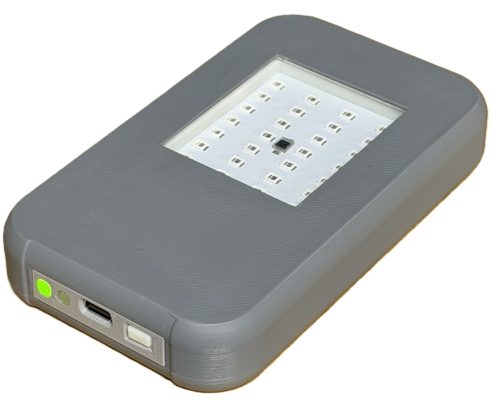
Every other device gives you a timer. Rejuvulite gives you a dose. You set a target in J/cm² — for example, 10 J/cm² to a specific location. The device runs until that dose has been delivered, confirmed by optical contact sensing and logged to the session record.
Panels and handhelds alike operate the same way: set a time and hold still. But irradiance varies with distance, placement, and the unit itself — so the actual dose delivered is anyone’s guess. The Rejuv is designed to be used close to the skin — close enough that distance stops being a variable. Combined with per-unit NIST-traceable calibration, dose control becomes possible for the first time outside a clinical setting.
Consumer & mid-range panels
Good irradiance. No dose.
Credible panel devices emit roughly what they claim — but irradiance drops sharply with distance. At 1 cm (½ in) you might see 230 mW/cm². At 10 cm (4 in), 50 mW/cm². Because distance varies continuously and is not measured, no fixed time corresponds to a known delivered energy. “Stay within 15 cm (6 in)” isn’t a dose — it’s a range across which the delivered energy is undefined. There’s no number to set, and no way to know what was received.
Set a dose. Deliver it. Confirm it.
Contact aperture eliminates the distance variable. Per-unit calibration gives the device its own irradiance figure. The app calculates session time from that figure and stops when the target dose — in J/cm² — has been delivered. Optical contact sensing confirms placement throughout. The session record logs what was actually received.
Clinical systems
Dose control exists here — at clinical prices.
Research and clinical-grade photobiomodulation equipment provides calibrated, dose-controlled output. That precision has been the standard in peer-reviewed PBM research for decades. Until now, accessing it required a clinical setting.
to deliver 10 J/cm²
to deliver 10 J/cm²
to deliver 10 J/cm²
contact aperture
Session times calculated from SN-03 calibration values and will vary slightly by unit — the app computes the correct time for your unit automatically. 10–50 J/cm² at the surface is the range commonly cited for deeper-seated targets in peer-reviewed photobiomodulation literature. Zein, Selting & Hamblin, J. Biomed. Opt. 23(12), 2018 ↗
Why dose control matters
Why it’s different
Individual unit calibration
Every unit is measured with a Thorlabs PM100D / S121C before shipment. You receive the actual irradiance of your device, not a nominal specification shared across a production run.
Optical contact sensing
An ambient-nulling reflected optical measurement confirms consistent placement throughout each session. Contact quality is logged with every session — not inferred after the fact.
NFC session telemetry
Session data is stored on the device via NFC tag. No background connectivity, no account required. A companion iOS app visualizes session history and contact quality over time.
Joule-based dose delivery
Select a target dose in J/cm². The app calculates session time from your unit’s calibrated irradiance and stops when that dose has been delivered — not a nominal estimate based on LED specifications.
Companion app
See your session.
Verify every dose.
The Rejuv app retrieves session data from the device via a simple NFC tap. No account required, no background connectivity — your data stays on your device.
- Select a target dose in J/cm² — session runs until that dose is delivered against your unit’s calibrated irradiance
- Dynamic Optical Response chart — a real-time view of contact stability across the full session, not a pass/fail indicator
- Session history with mode, duration, dose delivered, and contact quality per session
- Calendar view of usage patterns across time
- Available via TestFlight for early-access participants
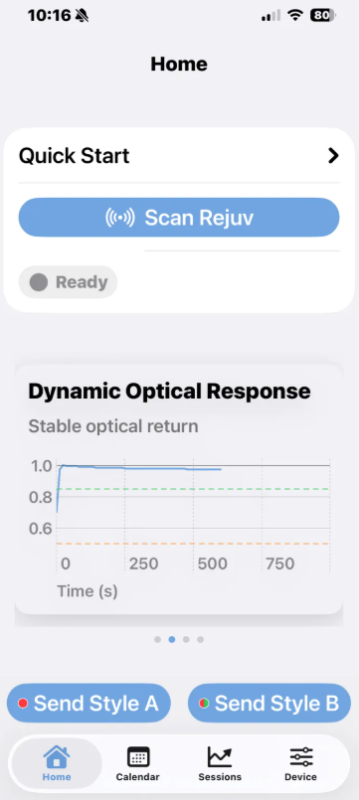
Dynamic Optical Response
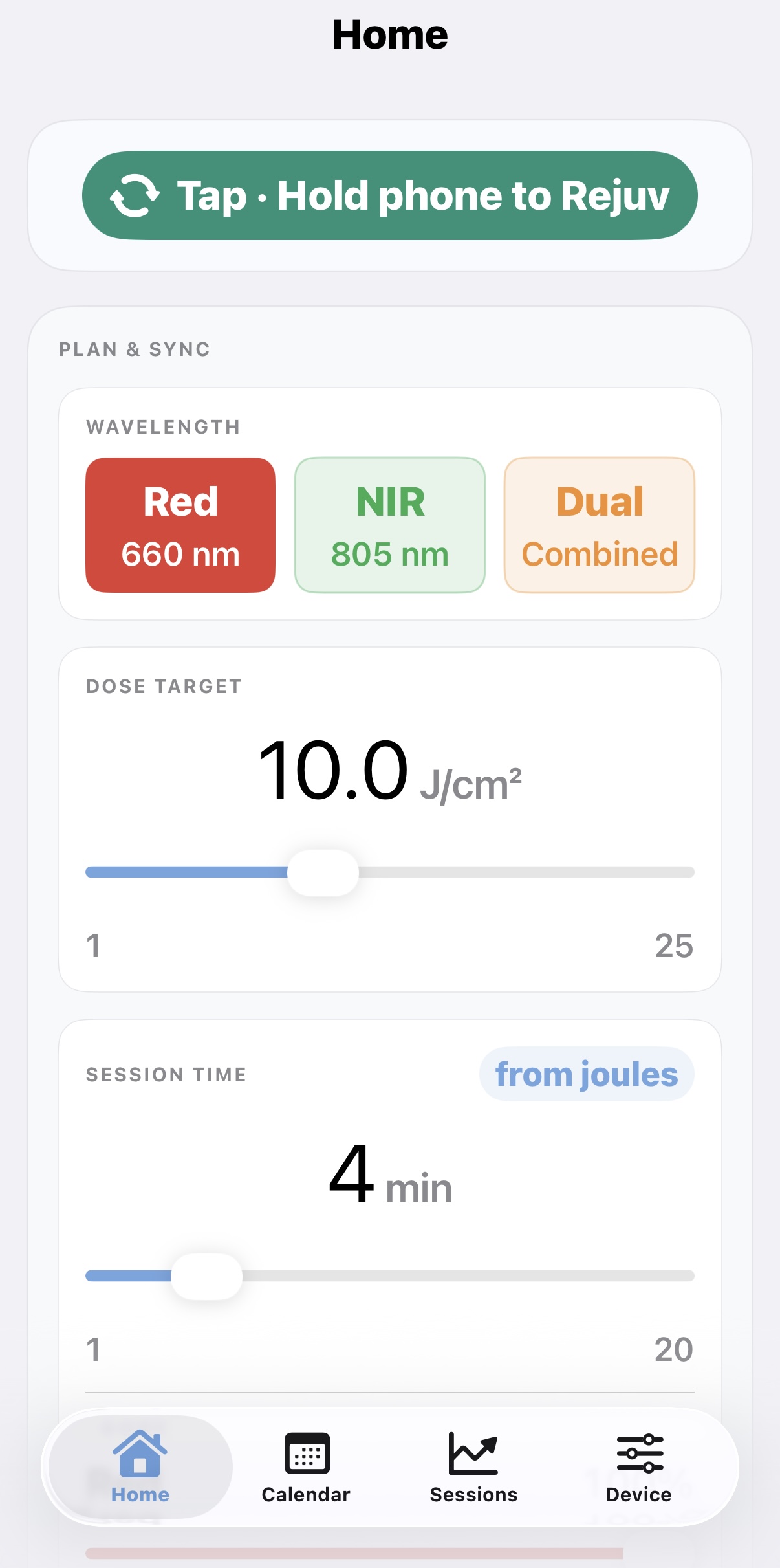
Dose control UI
Per-unit calibration record
Your unit’s actual numbers — not a batch average.
Most devices ship with a nominal spec derived from a sample unit or an electrical input estimate. Every Rejuv ships with a calibration record tied to its serial number, measured individually before shipment.
Measurement performed with Thorlabs PM100D / S121C (NIST-traceable), at near-contact geometry after thermal stabilization — conditions representative of actual use, not optimized for peak output.
See full measurement methodology →Get early access
A small number of evaluation units are available. Suited to technically engaged users, practitioners, and anyone who wants to know exactly what their device is doing.
Hardware validated · NIST-traceable calibration · No obligation