
The Rejuv · Designed in California
Designed for dose control at home.
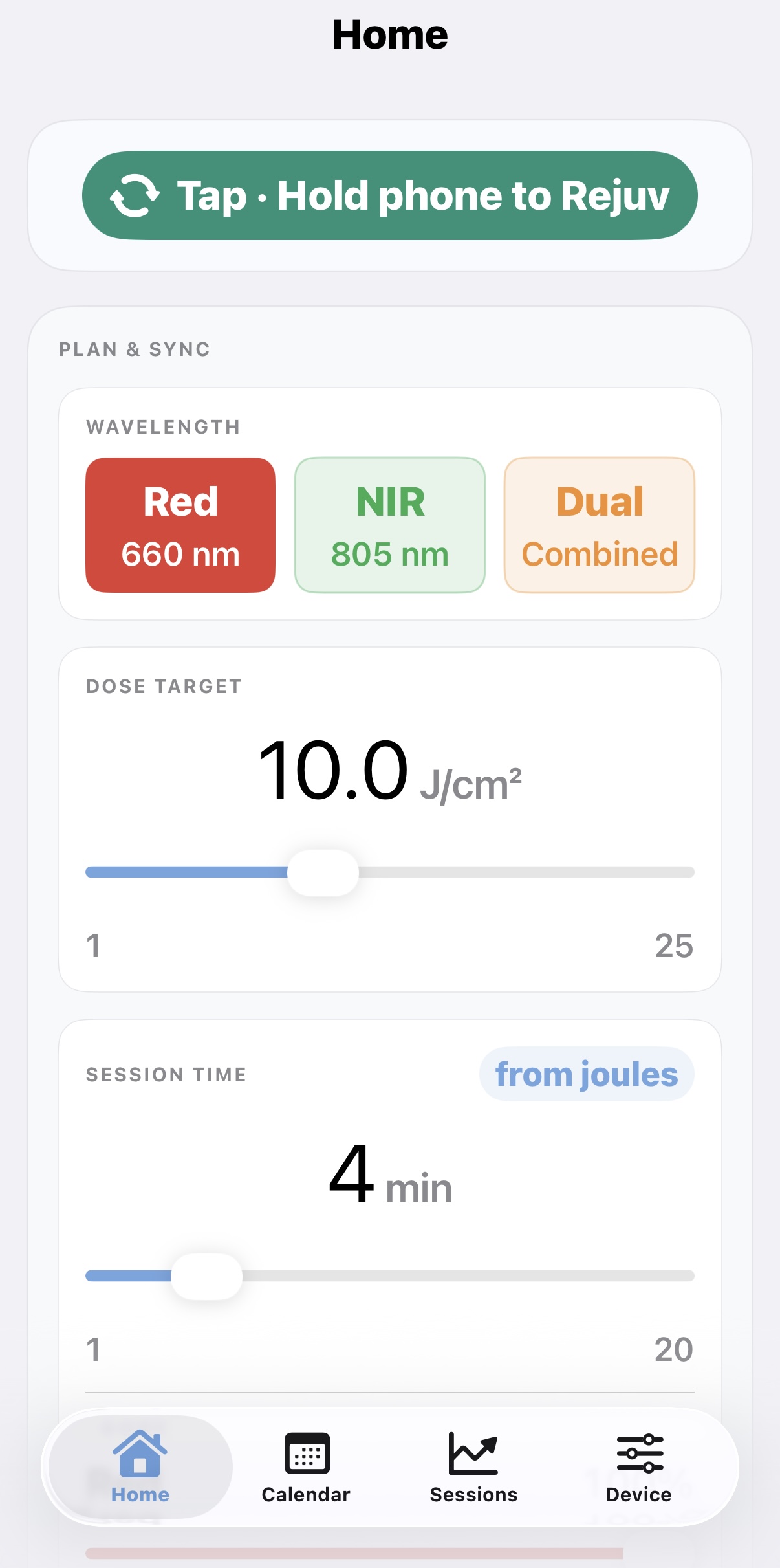
Set a target in J/cm². The Rejuv calculates the session time from its own calibrated irradiance, runs until that dose has been delivered, and logs the result. Based on calibrated output and verified contact — not nominal specifications.
10–50 J/cm² at the surface is a commonly cited range in photobiomodulation literature for deeper targets. Zein, Selting & Hamblin, J. Biomed. Opt. 23(12), 2018 ↗
Form factor
Sized for the work. Designed to stay there.
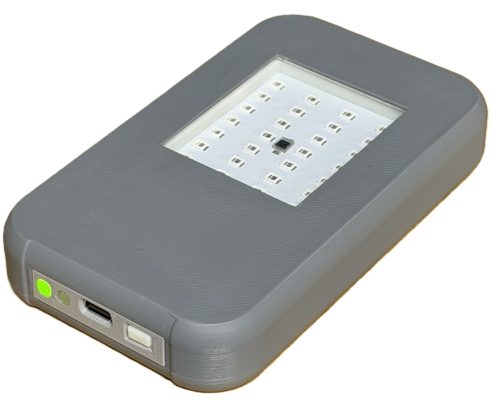
The Rejuv is sized for stable single-hand use over a defined 20 cm² (3.1 in²) treatment aperture. Weight and dimensions support a full session without a mount or stand.
The handheld near-contact format is deliberate — it’s what makes dose control practical. Because irradiance scales strongly with distance, even small changes in positioning translate directly into dose variation. Panel-based systems operate at varying distances and rely on the user maintaining consistent positioning. The Rejuv is designed to be held close to the skin, close enough that distance stops being a variable, and dose control becomes real rather than estimated.
Optical system
Your unit’s irradiance. Not a batch average.
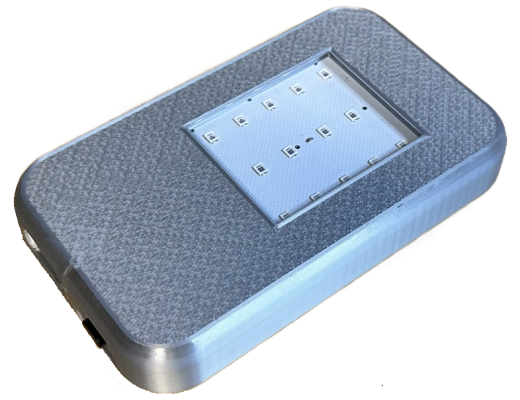
The Rejuv emits at 660 nm (red) and 805 nm (near-infrared) across a 20 cm² aperture. Every unit is individually measured with a Thorlabs PM100D / S121C before shipment — at near-contact geometry and thermal steady state representative of actual use, not optimized for peak output.
The app uses your unit’s specific calibration figure to calculate session time. The result is a dose that reflects what your device actually delivers, not what a nominal spec says it should.
View full measurement methodology →† Calculated from independently calibrated channels. Not directly measurable under simultaneous dual-channel operation.
Interaction model
One button. Works out of the box.
Every unit ships pre-configured to target 10 J/cm² — matching the reference session shown above. Press to start — the session runs to that target and stops. Mode can be changed on-device. The app adds dose customization, session history, and the Dynamic Optical Response chart.
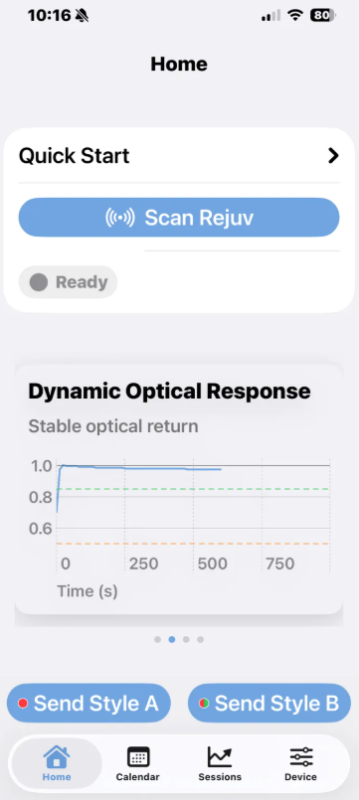
Session data — operating mode, output state, duration, contact quality, and dose delivered — is recorded locally throughout operation. A breathing LED indicates when contact falls below the session baseline. Solid means on target. If contact shifts significantly during a session, an audible chime alerts you immediately — so you can correct position in the moment rather than find out afterward in the session record. At session end, bring the device near your phone.
Typical session
From dose target to logged record
Companion app
Set the dose. See it delivered.
The Rejuv app handles session planning and session review. Session duration is derived from your unit’s calibrated irradiance — so the time the app suggests reflects what your device actually outputs, not a generic estimate. Set your target dose before you start. Retrieve the session record with an NFC tap when you’re done. No account, no background connectivity.
- —Select wavelength and set a target dose in J/cm² — session time calculated from your unit’s calibrated irradiance
- —Dynamic Optical Response chart — contact stability visualized across the full session, not a pass/fail indicator
- —Position deviation alert — if contact shifts during a session, a chime notifies you; the DOR chart shows exactly when and how much
- —Session history with mode, dose delivered, duration, and quality index per session
- —Calendar view of usage patterns over time
- —Available via TestFlight for early-access participants
Dynamic Optical Response
Dose control UI
Built for reproducibility
Contact quality is measured. Not assumed.
Contact quality is measured continuously via reflected optical signal at the aperture — not inferred from user compliance.
Each session generates a normalized quality index derived from operating consistency, mode selection, contact behavior, and duration. Sessions are timestamped and stored, allowing protocol adherence to be tracked across time.
Measured device performance is published. Session conditions are logged. Dose delivered, irradiance, duration, and geometry are all reconcilable against the calibration record. This allows session-to-session consistency to be evaluated, not assumed.
Manufacturing
Small batches. Individual calibration.
Current units are produced in small batches. Enclosures are fabricated via additive manufacturing; electronics are assembled and tested individually. This approach prioritizes iteration speed and direct traceability over cosmetic uniformity.
Each unit is individually calibrated prior to shipment using a NIST-traceable optical power meter. Measurements are performed at thermal steady state under near-contact conditions representative of actual use — not optimized for peak output.
Minor visual variation reflects the fabrication process, not a deviation from specification.
Summary specification
| Wavelengths | 660 nm (red), 805 nm (near-infrared) |
| Treatment area | 20 cm² (3.1 in²) near-contact aperture |
| Geometry control | Fixed near-contact aperture — distance not a user variable |
| Operating modes | Red only, NIR only, combined |
| Dose control | Target J/cm² set in app; session time calculated from unit calibration |
| Session duration | Determined by dose target and calibrated irradiance (typically 3–10 min) |
| Charging | Qi wireless and USB-C |
| Session logging | Automatic; NFC retrieval, no account required |
| Thermal management | Passive cooling; automatic output derating above 50°C. Formal thermal characterization in progress — extended back-to-back dual-mode sessions may require a brief interval between uses. |
| Contact sensing | Optical reflection measurement, continuous throughout session |
| Calibration | Individual NIST-traceable measurement; certificate included with each unit |
| Assembly | Small batch; enclosure via additive manufacturing |
Get early access
A small number of evaluation units are available for participants willing to provide structured feedback on usability and performance.