
1. Why measuring red light therapy output is difficult
Measuring red and near-infrared light therapy output is not as simple as reading a voltage or current, as can be done for electrical power. Electrical energy is confined within conductors and can be measured directly with probes placed at defined points in a circuit. Optical energy behaves very differently.
Accurate irradiance measurements depend on several factors, including:
- detector geometry
- wavelength sensitivity
- calibration method
- angular response
- distance between detector and source
- optical reflections from nearby surfaces
- source stability over time
Even small changes in measurement position or detector orientation can change the reported value significantly. For example:
Moving a detector only a few millimeters closer to a light therapy device can increase measured irradiance by several percent. Rotating the detector slightly away from normal incidence can reduce the measured signal unless the detector is cosine-corrected.
Because of these factors, accurate optical measurement requires defined geometry and calibrated instrumentation, not just a sensor placed “near the light.”
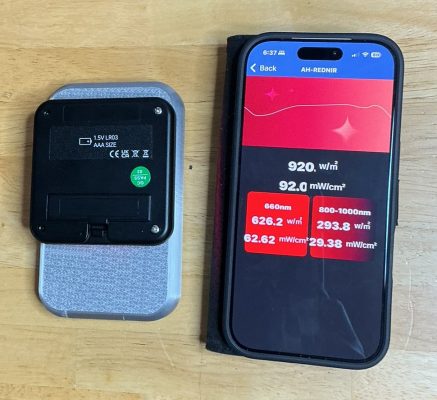
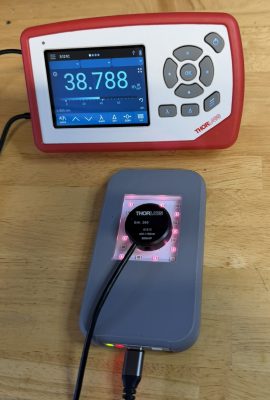
A common question is how accurate red light therapy meters really are, especially when comparing consumer meters to laboratory instruments. The images below illustrate this effect by comparing readings from a laboratory-class, NIST-traceable irradiance meter manufactured by Thorlabs with those from a lower-cost consumer meter measuring a comparable device.
Figure 1. Example measurement from a consumer-grade irradiance meter reporting approximately 92 mW/cm².
Figure 2. Measurement of a comparable device using a calibrated laboratory-class irradiance meter from Thorlabs showing approximately 38 mW/cm² under defined measurement conditions.
Differences like this are typically caused by detector calibration, spectral response, cosine correction, and measurement geometry rather than differences in the light source itself.
2. What should be measured (irradiance vs power)
The power emitted as light energy can be expressed in watts (W) or milliwatts (mW), just like electrical power. However, optical energy spreads through space instead of remaining confined inside a conductor.
As light travels away from its source:
- it spreads over a larger area
- its intensity decreases
- its spatial distribution changes
This spreading is why total optical power alone is not sufficient for evaluating light therapy performance.
Instead, what matters is irradiance.
Irradiance describes how much optical power arrives at a surface area:
irradiance = optical power per unit area
Typical units: mW/cm²
This is the quantity reported in photobiomodulation research because it directly determines how much energy reaches tissue. Consider two examples:
Example 1
A flashlight emitting 500 mW total optical power may deliver very little energy to tissue if the beam spreads widely.
Example 2
A device emitting the same total power over a smaller treatment area produces higher irradiance and therefore a stronger treatment effect but over a more limited area.
This distinction is explained in more detail here:
/specifications-guide/irradiance-vs-watts/
Photobiomodulation studies report irradiance at the treatment surface rather than total emitted optical power because biological response depends on energy delivered per unit area, not the total light output of the device.
3. Why cosine correction matters for LED panel measurement
Most LEDs used in red light therapy emit light over wide angles rather than as narrow beams.
This creates an important measurement challenge.
A detector without angular correction measures light differently depending on the direction from which the light arrives.
However, irradiance is defined physically as the total power incident per unit area from all directions above a surface, weighted by the cosine of the incidence angle.
A cosine diffuser solves this problem.
It ensures:
- light arriving straight-on contributes fully
- light arriving at shallow angles contributes proportionally less
- measured values match the physical definition of irradiance
Without cosine correction:
- angled light is under- or over-represented in measurements. In practice, most detectors without cosine correction tend to over-respond to light arriving at oblique angles. As a result, they often report irradiance values that are higher than the true surface irradiance when measuring LED arrays or therapy panels.
With cosine correction:
- measurements reflect the true treatment surface exposure
A cosine diffuser ensures that light arriving from different angles contributes proportionally to the measured irradiance, matching the physical definition of power per unit area.
This is one of the key differences between consumer light meters and instrumentation-grade optical measurement systems.
4. Spectral mismatch in photodiode irradiance meters
Another often overlooked issue in irradiance measurement is spectral mismatch.
Photodiodes do not respond equally to all wavelengths. Instead, each detector has its own spectral sensitivity curve, meaning the electrical signal produced depends not only on how much light is present, but also on the wavelength of that light.
For example, a detector calibrated using a broadband white-light source may not measure narrowband LEDs accurately unless spectral correction is applied.
An example responsivity curve from a photodiode used for this type of measurement is shown below. Although the detector may be specified for operation across a wide wavelength range (for example 600 nm to 1750 nm), its sensitivity still varies significantly within that range. Typical therapy wavelengths are indicated by vertical markers ranging from 660 nm (red) to 850 nm (near-infrared).
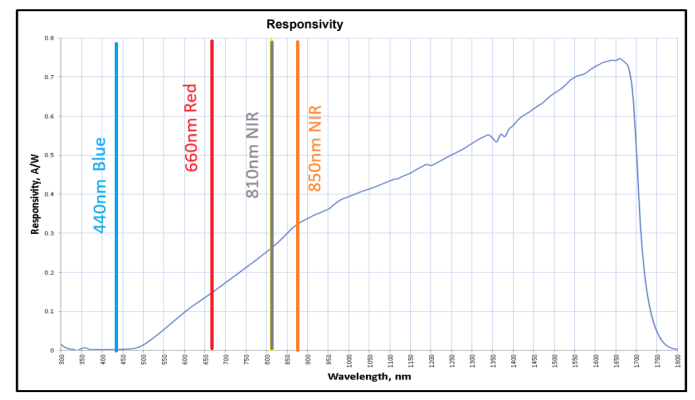
Because photodiode responsivity increases substantially between 660 nm and 850 nm, the detector produces roughly twice the electrical signal at 850 nm compared to 660 nm for the same optical power. If calibration is performed at one wavelength but measurements are taken at another, the reported irradiance can differ by more than 100% unless spectral correction is applied.
The exact magnitude of this effect depends on the detector type and calibration method, but the example shown illustrates how strongly wavelength can influence measurement accuracy if spectral mismatch is not addressed.
This is one reason two different optical meters can report significantly different irradiance values when measuring the same light therapy device—especially if the detectors are not calibrated specifically for the wavelength of the LEDs being measured.
Professional optical power meters address this by applying wavelength-dependent calibration factors based on the detector’s measured responsivity curve.
5. Distance effects when measuring LED therapy devices
Irradiance changes rapidly with distance from a light source.
This occurs because optical energy spreads outward as it travels. As the same amount of light is distributed over a larger area, the intensity at any one location decreases.
For small sources such as hand-held devices, irradiance approximately follows the inverse-square law, meaning the intensity decreases roughly in proportion to the square of the distance from the source.
However, for LED panels and multi-LED arrays, the situation is more complex. Beam divergence, emitter spacing, and optical overlap between neighboring LEDs all influence how irradiance changes with distance. As a result, measurements taken at different distances can vary significantly even when the total optical output of the device remains unchanged.
In practical terms, changing measurement distance from contact to just 5 cm can reduce measured irradiance dramatically depending on the device geometry.
Because of this, reporting irradiance without specifying measurement distance makes comparisons unreliable.
For example, two manufacturers may each report an irradiance of:
100 mW/cm²
But if one measurement is taken at contact distance directly over an LED and the other at a distance of 6 inches, the values are not directly comparable.
Reliable optical measurement therefore requires reporting the full measurement geometry, including:
- measurement distance
- detector aperture size
- detector orientation
- measurement location relative to the device surface
Defined measurement geometry is essential for meaningful comparison between devices. For this reason, photobiomodulation studies and optical measurement standards typically specify both detector position and measurement distance when reporting irradiance values.
6. Comparing inexpensive and laboratory irradiance meters
Measurement credibility depends heavily on calibration traceability.
Professional optical measurements rely on detectors calibrated against national reference standards such as those maintained by NIST (National Institute of Standards and Technology).
Calibration traceability provides:
- known detector responsivity
- documented uncertainty bounds
- repeatable measurement confidence
- long-term measurement consistency
A calibrated optical power meter includes:
- wavelength-dependent responsivity calibration
- traceability documentation
- uncertainty specification
Measurements reported on this site are made using a calibrated optical power meter with traceability to national standards.
This allows results to be:
- repeatable
- verifiable
- comparable across devices
Traceability is one of the strongest indicators that optical measurements are being performed correctly.
7. Practical measurement checklist
To measure irradiance correctly:
- Use a cosine-corrected detector
- Measure at a defined distance
- Match detector spectral response to LED wavelength
- Use calibrated instrumentation
- Report units as mW/cm²
- Document measurement geometry
When these conditions are satisfied, irradiance measurements become reliable and comparable across devices.