
Watts Say Little About Red and Near-Infrared Light Therapy Effectiveness
Irradiance (mW/cm²) determines how quickly energy is delivered to the treatment area and is the parameter used in clinical photobiomodulation research to define treatment intensity.
Why wattage is commonly advertised for LED panels
Many red and near-infrared therapy panels are marketed using wattage alone. If you’ve looked at red and near-infrared photobiomodulation devices, you’ve likely seen power advertised in watts:
- “100W panel”
- “300W device”
- “high power output”
While this seems that it might be easy to compare devices, in practice, watts tell you very little about how much therapeutic light actually reaches your skin.
What matters is something very different:
Irradiance — measured in milliwatts per square centimeter (mW/cm²)
This is the parameter that determines dose, effectiveness, and consistency.
Electrical input power describes device consumption, while irradiance describes treatment intensity at the treatment surface.
This diagram shows the relationship between electrical input power and irradiance at the treatment surface. Electrical power is first regulated by driver electronics, then partially converted into optical output by LEDs. That optical output is distributed across the treatment area and spreads further with distance, reducing the amount of light reaching the surface as usable irradiance. Because of these factors, electrical watt ratings alone do not indicate treatment intensity in photobiomodulation applications.
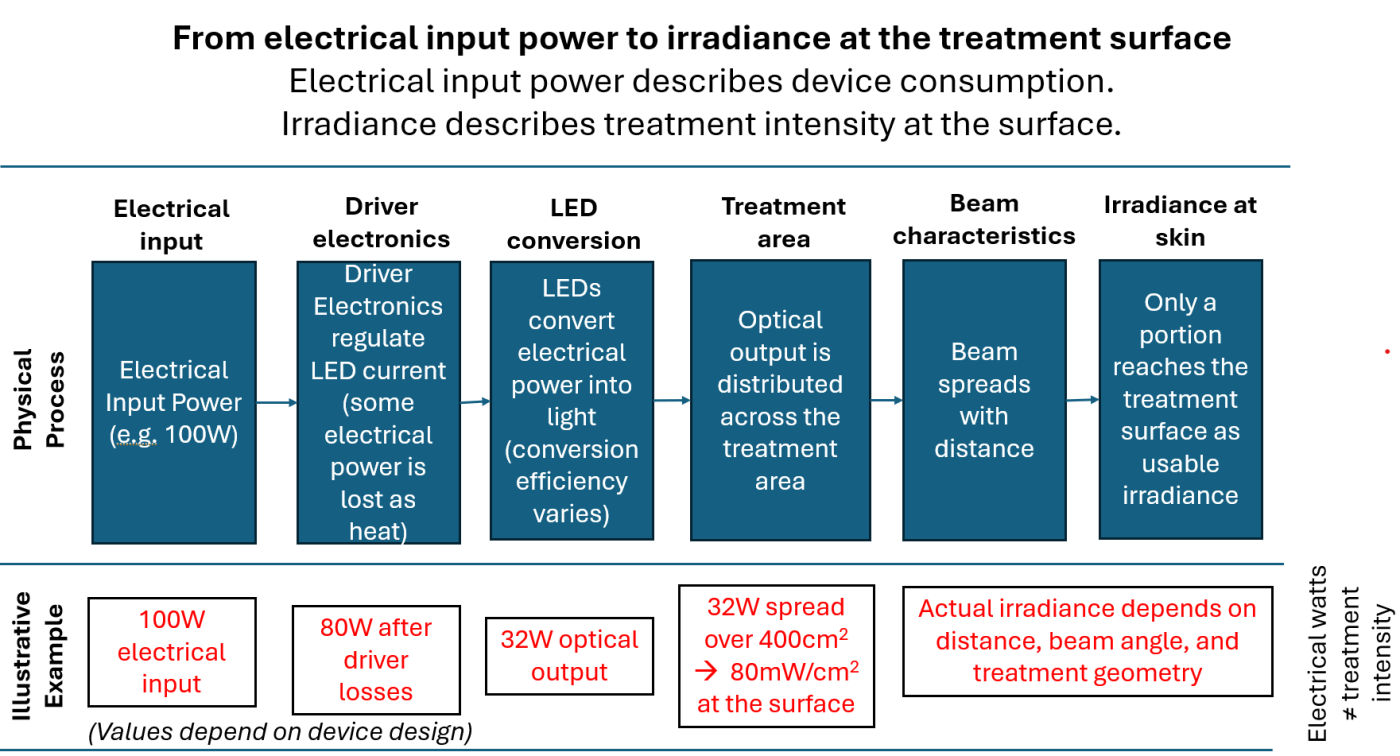
Electrical input power describes how much energy a device consumes. Between the power source and the treatment surface, driver losses, LED conversion efficiency, beam geometry, and distance determine how much usable irradiance actually reaches the skin.
Clinical photobiomodulation studies report irradiance in mW/cm² because treatment effectiveness depends on the energy delivered per unit area rather than total electrical input power.
What Watts Actually Measure (Electrical Input Power)
Watts describe electrical input power, not therapeutic output.
For example:
- A “100W” device may consume 100 watts from the wall
- Only a portion of that becomes light
- Only part of that light reaches your skin
- Only a fraction may be within the specific wavelength range responsible for the biological response you want.
Losses occur due to:
- LED efficiency
- optical spread
- distance from the skin
- reflection and scattering
So two devices both labeled “100W” can deliver dramatically different results.
What Irradiance Measures
Irradiance is defined as:
Optical power delivered per unit area at the skin
Units: mW/cm² (milliwatts per square centimeter)
This tells you:
- how much light reaches your skin
- how concentrated that light is
- how quickly energy is delivered
This is the parameter used in:
- clinical research
- photobiomodulation studies
- dose calculations
These specification differences are summarized below:
Why Irradiance Determines Dose
Photobiomodulation effectiveness is governed by energy delivered over time:
Dose (J/cm²) = Irradiance (mW/cm²) × Time (seconds) / 1000
This relationship allows treatment time to be adjusted once irradiance is known.
This means:
- Doubling irradiance halves the time required to reach a specific amount of energy
- Low irradiance requires much longer sessions
- Excessively high irradiance can reduce effectiveness (biphasic response)
Without knowing irradiance, you cannot determine dose.
| Specification | What it describes | What it does NOT describe |
|---|---|---|
| Watts | Electrical input power | Light reaching skin |
| LED count | Array size | Delivered dose |
| Irradiance | Optical power at skin | ✔ treatment intensity |
Power in Watts does not specify irradiance
Many devices advertise a specific power number, but do not specify how this relates to irradiance. If irradiance is specified (e.g. >100mW/cm²) it is not often specified where this measurement was taken and if it is what you can expect to achieve through a session and where the panel should be placed to obtain this dose. What is not specified is:
- beam angle
- measurement distance
- actual irradiance at the skin
- How consistent the irradiance will be over the duration of a session. The output of the LEDs and / or lasers is very sensitive to temperature and input current, such that maintaining optical output consistency even within ±10% over a treatment session is technically challenging.
This creates a situation where:
The number looks impressive but has no clinical meaning
Why Measurement Is Non-Trivial
Measuring irradiance accurately requires more than a simple sensor. Laboratory equipment often priced at thousands of dollars is required to obtain accurate measurements. This is due to factors such as:
- Spectral mismatch, as photodiodes measuring the energy respond differently to the specific wavelength (or color being emitted). Without adjusting for the wavelength, even different shades of “Red” can result in considerable errors in the irradiance measurement.
- Cosine response, or light arriving at an angle can have a considerable impact. It might seem that if the measurement device is simply aimed straight at the source, the measurement should be accurate, however LEDs not directly pointed at the detector arrive at different angles, which can result in significant errors in the measurement. This requires a cosine-corrected diffuser.
- Distance and geometry, as small changes in position can significantly affect readings.
- Calibration, accurate measurement requires traceable calibration (e.g., NIST standards).
There is no single “correct” irradiance level, but there is a correct dose.
There are more than 11,000 studies on photobiomodulation, most of which report dose in J/cm² rather than watts. These studies generally require at least ~5 mW/cm² at the treatment surface, and outcomes depend on both irradiance and exposure time, which together determine dose. For a lower irradiance, more time is required. For a higher irradiance, if too much time is used, the effectiveness actually drops.
- More is not always better
- Consistency and providing the proper dose of energy are what matter.
How to Evaluate a Device
When comparing devices, ask:
- What is the irradiance at a realistic distance?
- How was it measured?
- Is the measurement wavelength-specific?
- Is the sensor calibrated?
- When looking at numbers, other articles, such as my Medium publication, can help you determine if they seem reasonable. For example, if 100mW/cm² or 0.1W/cm² is specified in a panel that has a surface area of 200 cm² (about 5.5in x 5.5in), and then considering exceptional efficiency is 20%, is it really reasonable to believe the device is using 100W of power? For those of us that remember, would you realistically expect to hold a 100-watt incandescent bulb close to your skin for 5–10 minutes without burning yourself?
If these answers are unclear, the number is likely not reliable.
Ask – “How much irradiance reaches my skin and how long do I have to use it?”
That shift alone leads to better decisions.
For measured output data under realistic treatment conditions from Rejuvulite, see:
Conclusion
Watts describe input power.
Irradiance describes delivered energy.
It is Irradiance that determines dose.